
Skin barrier biology
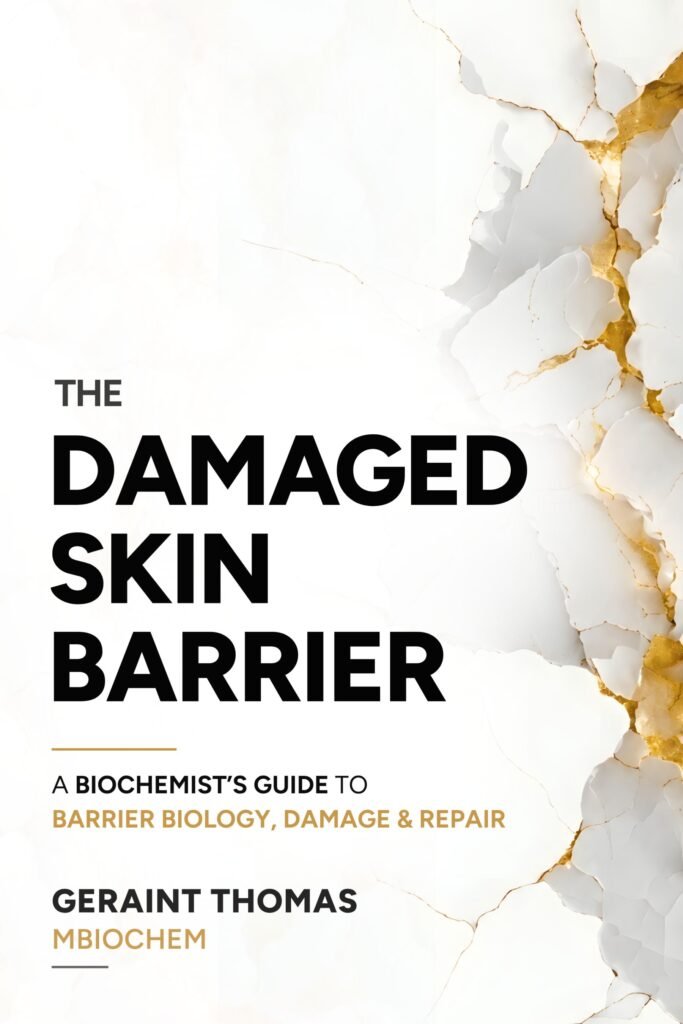
The Damaged Skin Barrier.
A biochemist’s guide to
barrier biology, damage and repair.
Author
Geraint Thomas
Chapters
11
Publishing
22 October 2026
Editions
Hardback, paperback, ebook
From Chapter 7
External lipids cannot bypass the skin’s own regulatory machinery. They arrive at the surface, and what happens next depends on how well the conditions for integration are in place. If pH is still elevated, enzymatic conversion of lipid precursors is less efficient. If protease activity is poorly regulated, lamellar organisation remains unstable.
The Damaged Skin Barrier
What this book is
A framework for reading the skin, not a routine for following.
Most books on skin either chase trends or sell routines.
This one builds a model.
Mechanism-first
Grounded in the biology, not the marketing
Every claim connects back to primary literature. Where the evidence is strong, the book says so. Where it’s contested or early, it says that too. You get the state of the field, including the parts of it that aren’t settled.
Structural
Built around three systems, not ten steps
Barrier behaviour is framed through structure, regulation and pressure. Symptoms, products and environmental exposures all sit inside those three systems. Once the frame is in place, things that looked unrelated stop being unrelated.
Figure-supported
Visuals where the explanation needs support
Twenty-four original figures, drawn for this book. Where the biology gets heavy, the figure carries the meaning and the prose carries the explanation. If a passage is hard going, read the figure first and come back to it.
Deliberately non-prescriptive
No routines, no product lists, no promises
No universal routine exists, because barrier function depends on too many variables for one to be honest. What you get instead is the ability to read what your skin is responding to, and to decide from that.
How this book is structured
Eleven chapters, three systems, one throughline.
The structure is deliberate. Each chapter assumes knowledge from the previous ones. By the time you reach repair, the reasons it works the way it does are already clear.
CH / 01
When Skin Stops Making Sense
Why skin feels contradictory, unpredictable, and harder to interpret than the advice around it suggests. Barrier damage reframed as a problem of structure, regulation, and pressure rather than a random collection of separate symptoms.
Framework · Foundations
CH / 02
The Infrastructure
What actually makes the barrier a barrier. Inside the stratum corneum: corneocytes, the intercellular lipid matrix, ceramide subclasses, the calcium gradient, and why resilience depends on molecular architecture rather than surface appearance.
Structure · Core Biology
CH / 03
The Acid Mantle and Enzymatic Control
The acid mantle, KLK activity, LEKTI, and the pH-dependent enzyme systems that coordinate barrier function. When coordination drifts, the consequences are biochemical long before they become visible. Why your skin can feel wrong for weeks before anything changes on the surface.
Regulation · pH dynamics
CH / 04
The Microbiome and Barrier Ecology
The microbiome brought back to biology: pH, lipid metabolism, immune signalling, and microbial balance. Why dysbiosis is usually a consequence of barrier disruption before it becomes a cause of it, and why adding bacteria to a compromised surface rarely produces stable change.
Regulation · Ecology
CH / 05
Biochemical Pressure
Retinoids, acids, exfoliants, and surfactants promise results through different mechanisms. What they share is biochemical pressure — cumulative load on a system that may already be compromised. Why stacking actives often accelerates instability rather than correcting it.
Pressure · Actives
CH / 06
The Reset
When skin is unstable, the hardest thing to do is nothing. But restraint isn’t passive, it’s the most active part of repair. What changes when pressure stops, why sensation recovers before structure, and why feeling better is not the same as being rebuilt.
Repair · Practical Centre
CH / 07
Biomimetic Repair
Once pressure is reduced and regulation begins to recover, support becomes the question. When hydration, emollients, occlusion, and lipids genuinely help, and why the right support at the wrong time can still slow recovery rather than speed it.
Repair · Support
CH / 08
The Hard Water Variable
What if the problem isn’t the product, but the water? Almost never discussed in skincare, despite interacting directly with surfactants, disrupting lipid organisation, and impairing pH recovery after cleansing. The actual chemistry of mineral-rich water meeting skin.
Environment · Chemistry
CH / 09
The Atmospheric Variable
Sometimes the routine hasn’t changed; the environment has. How UV, cold, wind, and humidity shift barrier behaviour in ways that topical routines can’t override. Why your skin destabilises in winter or flares after a flight, independent of what’s in the bottle.
Environment · Climate
CH / 10
Systemic Signals
Why your skin falls apart when you are stressed, sleep-deprived, or hormonally shifting. How cortisol suppresses lipid synthesis, how circadian rhythms govern repair timing, and why your routine can be perfect while your biology works against it.
Internal Biology · Systems
CH / 11
Emerging Therapies and Innovation
New skincare is easy to market, because novelty sounds like progress. This chapter asks the better question: does the intervention actually work with barrier biology? Peptides, procedures, exosomes, devices, and microbiome therapies judged by compatibility, not hype.
Evaluation · Emerging Therapies
Who this book is for
Written for readers who want explanation before recommendation.
If any of the following sound familiar, the book was written with you in mind.
- Reader profile / 01
Your routine keeps getting longer, and your skin keeps getting worse.
Products stacked on top of products. Each one promising to fix what the last couldn’t. The book reframes the problem so you can stop adding and start reading what the skin is responding to.
- Reader profile / 02
Products that used to work have started stinging.
Tolerance has quietly narrowed. The same formulas that were unremarkable for months now feel harsh. The shift isn’t the products. It’s what the barrier can still absorb without reacting, and the book explains why that window moves.
- Reader profile / 03
Your skin feels contradictory and you can’t find the pattern.
Tight and oily. Calmer on the surface, reactive underneath. Better in the morning, worse by evening. These stop being separate problems when the regulatory systems underneath are understood together.
- Reader profile / 04
You want biology over buzzwords.
You’ve read the articles, you’ve heard the claims, and you want to understand what is actually happening beneath the surface before being told what to buy. This is a book for people who prefer mechanism to marketing.
FROM THE BOOK
Skin that doesn’t make sense is usually answering a question you haven’t asked yet.
A sample from the book
From Chapter 1 · When Skin Stops Making Sense
Section 1 · How Skincare Learned to Name Symptoms Instead of Systems
The language most people use to describe their skin didn’t originate from biology. It emerged from categorisation.
As the skincare industry expanded, consumers needed simplified ways to navigate an increasingly crowded market. Broad labels became useful: oily, dry, sensitive, combination, normal. These categories made product selection easier and recommendations feel personalised. They also fundamentally reshaped how people interpret their own skin. Within this framework, temporary conditions began to sound like fixed identities. Oiliness implied overproduction. Dryness implied deficiency. Sensitivity implied inherent fragility. Each state appeared to demand correction, often with a dedicated product range or routine. What began as convenience evolved into belief.
The difficulty is that these categories describe appearance and sensation, not function. They tell you what skin looks or feels like at a given moment, but say very little about why it behaves that way or how multiple symptoms may be connected. Skin that feels tight and shiny doesn’t fit neatly into ‘dry’ or ‘oily’. Skin that stings without redness challenges the idea of ‘sensitive’. Flaking alongside congestion contradicts the expectation that problems occur one at a time. Yet the model persists because it is simple. Biology, unfortunately, is not.
From a physiological perspective, skin behaviour is dynamic. Sebum output fluctuates. Water retention shifts with humidity. Reactivity changes with inflammation, barrier integrity, stress, sleep, hormones, and environmental exposure. The same person can experience oiliness, tightness, and sensitivity across different contexts without undergoing a change in ‘type’. The limitation is not your skin. It is the interpretive framework imposed upon it.
This symptom-first approach explains why routines often become progressively complex. Each new sensation invites a new solution: oil gets stripped, dryness gets layered, texture gets scrubbed. Relief may occur. Stability rarely does.
Preface
I spent the better part of two years making my skincare routine more complicated and my skin considerably worse. Tightness one day, oiliness the next, random stinging, products that worked for months and then didn’t. My routine was absurdly complex. I got quiet satisfaction from a lineup of serums as long as my arm, all arranged alphabetically in my bathroom cabinet, as if organisation alone could fix the confusion.
The thing that broke the pattern was a retinol purge that lasted far longer than any of the standard explanations could account for. Six months in, I stopped adding products and started reading papers. Not to write a book. To find a way out.
The biology exists. The mechanistic explanations exist. They are scattered across primary research that most people will never open, written in a language that doesn’t translate easily, and almost entirely absent from anything aimed at a general reader. Social media is full of hype and overnight transformations. Even thoughtful professionals sometimes lean on long product lists that leave you wondering whether you’re getting honest opinion or subtle endorsement. The clarity I was looking for didn’t exist in one accessible place, so I built it.
This book is not prescriptive. It is mechanistic. It won’t give you the perfect routine, a shopping list, or a timeline for retinol purging. What it will give you is a framework, grounded in how the barrier actually works, so you can make decisions based on what your skin is telling you right now rather than what a product label implies it should be.
Where the biology becomes dense, figures accompany the text. If a passage is heavy going, the figure carries the essential architecture. Read the figure, then return to the prose.
The goal is a quieter relationship with your skin. Instead of the reflex of buying yet another serum in sleek clinical packaging, you get the deeper satisfaction of putting it back on the shelf and thinking: ‘that’s not for me. I know better now.’
I spent too long looking for this clarity. You’ve found it.
How this book is different
Most skincare advice is about products. This one is about the system those products are acting on.
Most skincare advice
Organise by product category. Cleanser, toner, serum, moisturiser, SPF. The reader learns what to buy in each slot and in what order.
The damaged skin barrier
Organises by biological system. Structure, regulation, pressure, repair. The reader learns what the skin is actually doing, so product choice becomes a consequence of understanding rather than the starting point.
Most skincare books
Cite ingredients. Mention hyaluronic acid, niacinamide, retinol, and explain what each does in general terms.
The damaged skin barrier
Cites primary literature. Every claim links to the research it rests on, with complete references available at the platform level. No ingredient is described in isolation from the barrier state it’s being asked to act on.
Most skincare books
End with a universal routine. Step one, step two, step three. Works for everyone, allegedly.
The damaged skin barrier
Ends with a framework. No universal routine exists, because barrier behaviour depends on too many individual variables for that to be honest. What the reader takes away is the ability to read their own skin, in their own environment, in real time.
Most skincare books
Are written by skincare industry voices with commercial relationships to products they recommend.
The damaged skin barrier
Is written by a biochemist with no product relationships, no affiliate revenue, and no brand partnerships. Written from primary research, not from a shelf.
About the author
The book I went looking for and could not find.
I started learning the backstory to The Damaged Skin Barrier six months into a retinol purge that had stopped being a purge and become something else. I’d added products, removed products, gone minimal, rebuilt, and nothing was reading the same way twice. What I wanted was a mechanistic explanation.
What I found was hype on one side of the conversation, and fragmented, paper-by-paper biology on the other, with almost nothing bridging them for a general reader.
I hold a First Class MBiochem from Cardiff University, with research grounded in TNF-family and apoptotic signalling within cancer models, and the biology of how tissues respond to pressure. The barrier is one expression of those principles, and the book is the first output of a wider platform applying them to the skin.
- Credentials & Context
Author
Geraint Thomas
Biochemist, writer, platform builder & founder
Education
MBiochem, First Class
Research
European Cancer Stem Cell Research Institute
Platform
Geraint Thomas Bio
Independence
No product partnerships
Frequently asked questions
Questions worth answering.
Is this a routine book or a product-recommendation book?
Neither. No universal routine is given, and no products are recommended. The book deliberately avoids that format because it would undermine its own central argument. What the book provides is a framework for reading what your skin is responding to, and the biology to back that framework up.
Do I need a scientific background to read it?
No. The book assumes no prior biology. Where the mechanisms are dense, figures carry the essential meaning and the text explains the implications. Where terminology matters, it is introduced in context rather than assumed. Readers with scientific training will find the references and depth worth their time; readers without will find the explanations reachable.
When will it be available, and where?
Publication is 22 October 2026, in hardback, paperback and ebook. It can be ordered through normal UK book-trade channels, and by libraries, universities and clinics using its ISBN. The launch list gets the release date and nothing else. No newsletter, no spam.
Is the book suitable for acne, rosacea, eczema, or sensitive skin?
Barrier dysfunction runs through acne, rosacea, eczema, perioral dermatitis and general reactivity. The book isn’t condition-specific, but the regulatory and structural systems it covers sit underneath all of them, whichever presentation is most visible on the surface. Diagnosis and prescribing still belong with a dermatologist.
Does the book work alongside a dermatologist’s advice?
Yes, and that’s the intended context for many readers. The book is a framework for understanding what is happening beneath the surface of the skin. A dermatologist diagnoses and prescribes. Those functions are complementary rather than in conflict.
published 22 cotober 2026