Your skin is reactive. You’ve accepted that the problem probably isn’t the product. You’ve resisted the urge to order three new serums at midnight. You’ve stripped things back. And now you’re sitting with a bare-bones routine, staring in the mirror, wondering: is this actually doing anything?
It doesn’t feel like it. Nothing looks better. If anything, it might actually look worse. It’s driving you mad that you feel like you should be doing something, but you’re doing nothing. This is the part that matters most, and it’s the part almost everyone gets wrong.
Your Skin Isn’t Resting. You Are.
When pressure stops, your skin doesn’t enter some kind of standby mode. It shifts into active recovery. That recovery just doesn’t look the way you’d expect it to.
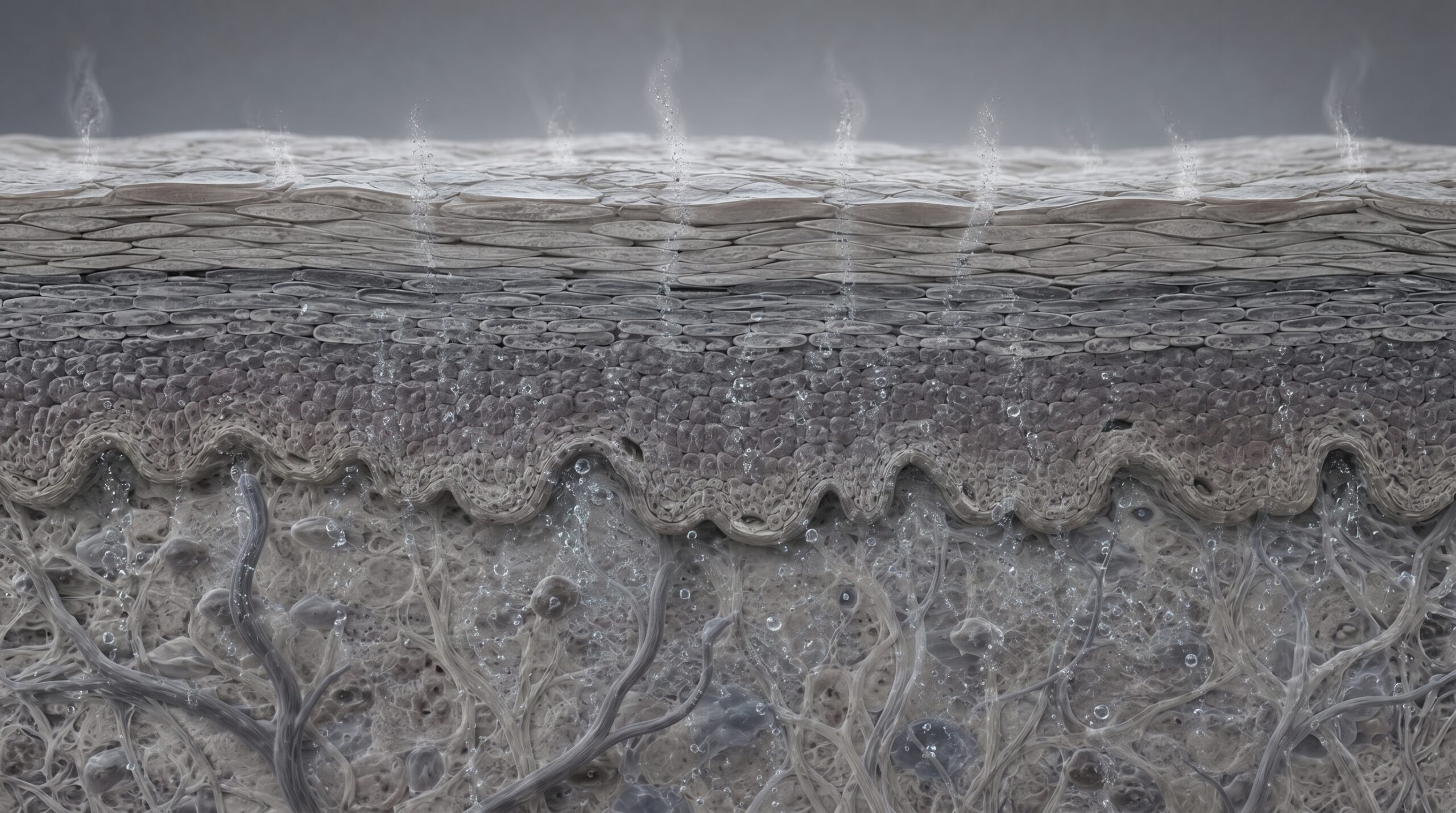
Within hours to days of removing the inputs that were provoking it (the acids, the over-cleansing, the constant product rotation), inflammatory signalling starts to drop. The enzymes responsible for shedding, which were running ahead of schedule, begin to slow down. Surface pH starts to stabilise. Sensory nerves, no longer being constantly triggered, begin to quieten.
This is real biological progress. It’s also invisible. You won’t see it in the mirror. What you will notice is that water stops stinging. Products that were intolerable feel manageable again. The tightness that had become background noise starts to ease. Your skin feels calmer.
And this is exactly where things go wrong.
Feeling Better Is Not the Same as Being Rebuilt
That early calm is genuine, but it’s misleading. What’s improved is sensation. What hasn’t improved, not yet anyway, is structure.
The relief you feel in the first few days comes from your nervous system settling down, not from your barrier being repaired. Inflammatory signals have reduced, so the threshold for stinging and burning has risen. Hydration has improved slightly, so corneocytes are more flexible and the surface feels less rigid. These are real changes. They’re just not the changes that determine whether your barrier can hold up when you start asking more of it again.
The architecture underneath – the lipids, the organisation, the cohesion that actually makes the barrier functional – operates on a completely different timescale. The cells on your surface right now were largely built under the conditions that caused the problem in the first place. The cells being built now, underground, under better conditions, won’t reach the surface for another month.
This is the gap that breaks most recovery attempts. You feel better, so you test something. A gentle acid. A new serum. A slightly more thorough cleanse. Nothing over the top. Nothing that stings. And for a few days, it seems fine. Then a week later, you’re back where you started, wondering what went wrong.
Nothing went wrong. The timing was wrong. You asked a system that had stopped getting worse to prove it was better, and it wasn’t ready.
Then Things Get Awkward
About one to two weeks into stripping a routine back, something reliably discouraging happens. The stinging has stopped. The acute reactivity has faded. And then your skin starts looking worse.
Oilier. Duller. Rougher. Maybe a few breakouts you weren’t expecting. The instinct at this point is to intervene. Treat the oil, address the texture, deal with the congestion. That instinct is almost always wrong.
What you’re seeing isn’t regression. It’s recalibration.
The oiliness often isn’t what it looks like. While the barrier is still restoring its ability to manage water loss, surface lipid balance shifts in parallel. Dehydrated cells change how light hits the skin, creating a shine that reads as greasiness even though the skin underneath still feels tight. Both things are true at the same time. This isn’t a contradiction, it’s a barrier in transition.
The texture changes follow similar logic. If your skin had been kept artificially smooth by constant exfoliation or acid use, removing that pressure means cells will accumulate at the surface for a while. The skin isn’t failing to shed. It’s shedding at a pace it controls rather than one you forced. That’s progress, even though it doesn’t look like it.
And the breakouts (the ones that feel like the opposite of healing), are often what happens when turnover normalises. Things that were being constantly cleared by exfoliation now surface as the skin resets its own rhythm. In most cases, this stabilises as the deeper repair catches up.
The Quiet Phase
After the awkward bit, recovery enters a phase with almost no feedback. Nothing is getting worse. Nothing is visibly improving. The skin just… sits there.
This is the hardest part to trust, and the part where most people give up. Not with a blowout product binge, but with a slow drift. A new moisturiser because the current one feels boring. An acid “just once” to deal with some texture. An extra cleanse because the skin seems like it can handle it.
Each of these is small. None of them sting. But they prevent the slow systems from finishing what they started. Lipids that were mid-assembly get disrupted. Enzyme coordination that was settling gets nudged off course. The barrier doesn’t send you a notification. It just takes longer. And you never know it could have been faster, because there’s nothing to compare it to.
If nothing is going wrong during this phase, something is probably going right. You just can’t see it yet.
How You Know It’s Working
Recovery doesn’t announce itself with a glow-up. It reveals itself through absence.
Water that used to sting doesn’t. Cleansing that used to leave tightness an hour later doesn’t. A cold day passes and you don’t spend the evening managing your skin. A product you’d been avoiding actually works and you barely register it. None of these are dramatic. That’s the point.
The clearest signal is independence. Early in recovery, your skin depends on consistent support. As repair progresses, the gap between applications widens. What was essential becomes optional. You won’t have to go to sleep with a thick layer of that unfragranced jelly smothered over your face. That shift from needing support to simply benefiting from it is what you’re looking for.
One useful test: reduce something and see what happens. Not aggressively – just skip the evening moisturiser one night, or rinse without cleanser in the morning. If your skin holds, the barrier is regaining control of its own regulation. If it collapses within a day, you’re still compensating. Both answers are useful. Neither is a failure.
You’re not looking for skin that never reacts. You’re looking for skin that recovers on its own.
The Finish Line You Won’t See Coming
There’s no single moment where recovery completes. There’s a day when you realise you haven’t thought about your skin. Not managed it well or made a good decision about it. Just… didn’t think about it. It handled an ordinary day without asking for your attention.
That’s functional resilience. Not invulnerability, or the permanent absence of any sensitivity. Just a system that handles ordinary life without needing to be managed.
If you’re in the thick of it right now (the awkward phase, the quiet phase, the phase where nothing seems to be happening) staying the course is the hardest and most productive thing you can do. Your barrier is doing the work. Your job is to stop resetting the clock.
The system that got you here knows how to get you out. It just needs you to stop competing with it.