
‘Drink more water’ is the skincare equivalent of ‘have you tried turning it off and on again.’ It gets offered for everything, explains nothing, and is technically not wrong in the same way that most unhelpful advice is technically not wrong.
You’ve heard it after a breakout. Perhaps it was recommended because you have dry skin. You’ve heard it when your skin was flaking, tight, dull, reactive, or simply off in a way you couldn’t quite explain. Someone, somewhere, said drink more water, and they said it with the confidence of a person who had genuinely solved the problem.
They hadn’t. Not because hydration doesn’t matter. It does, in the same way that sleep, not smoking and eating vegetables matter. The problem starts when a background condition gets treated like a direct fix. The relationship between the water you drink and the way your skin behaves is more complicated than your favourite refillable bottle can solve.
I believed it for a while myself, and I think the reason is simple. Dehydration’s other effects are impossible to miss: headaches, cramps and the fatigue that lifts within an hour of a proper drink. It’s a short, reasonable-sounding step from there to ‘it must be doing something similar for my skin.’ The step feels earned. It isn’t, because skin doesn’t hold water the way the rest of the body responds to losing it.
Your Skin Doesn’t Work Like a Houseplant
The standard model goes something like this: you drink water, it enters your bloodstream, travels to your skin and keeps it plump and dewy. Top up the tank and everything stays hydrated. Simple, logical and extremely misleading.
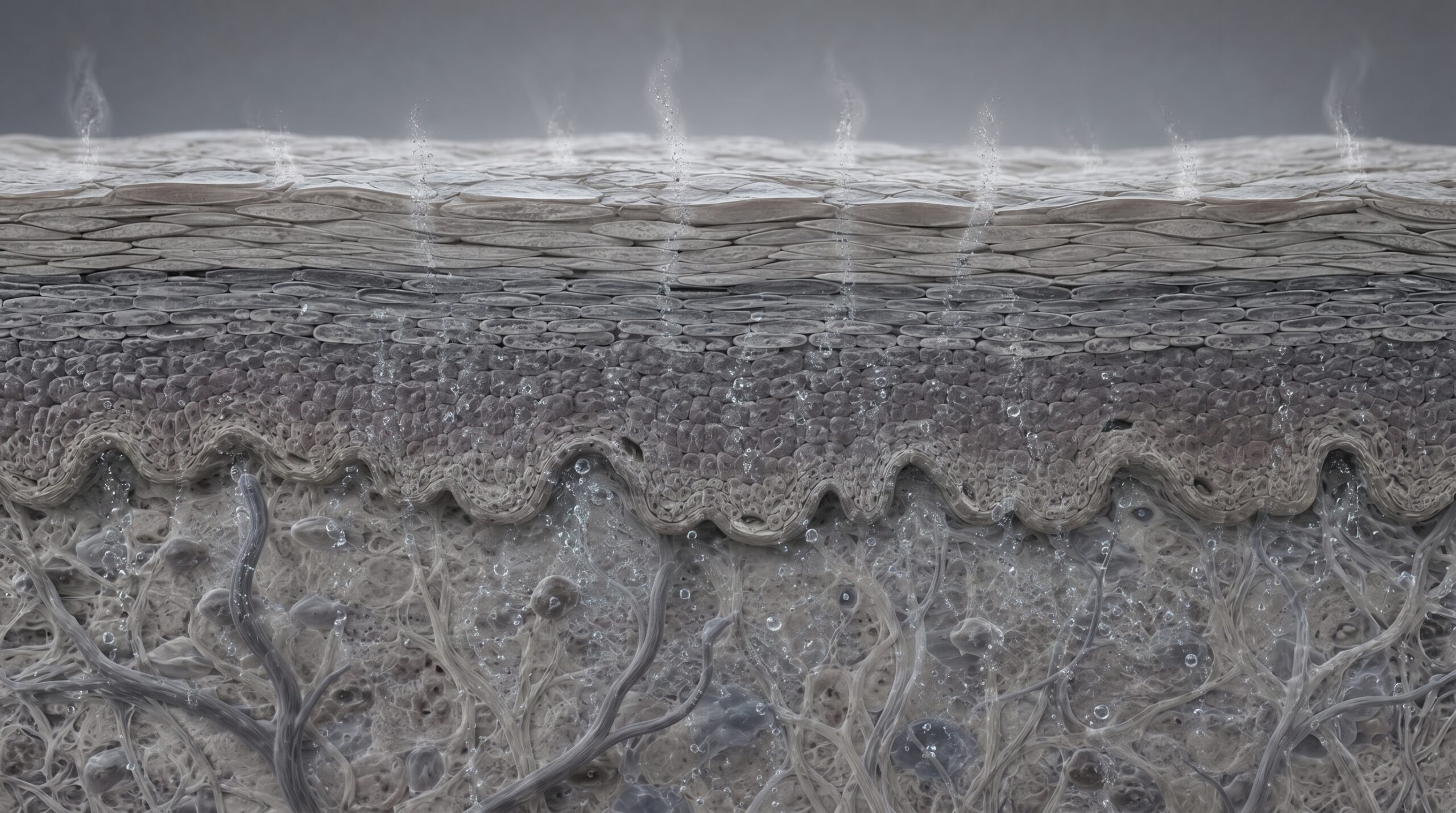
Water reaches the surface from within, but how much stays there depends less on supply than on how well the stratum corneum holds onto it. This outermost layer, the part you can actually touch, manages water in two main ways. It slows its escape into the environment and binds it inside corneocytes, the flattened, water-holding cells that make up the stratum corneum.
The binding is supported by Natural Moisturising Factor, or NMF. You may recognise the name from moisturiser labels, although within the skin it refers to a mixture of hygroscopic compounds held inside corneocytes.
Much of NMF comes from filaggrin, a structural protein that first helps compact keratin filaments as corneocytes form. Later, it is broken down into components including amino acids, pyrrolidone carboxylic acid and urocanic acid. These compounds are hygroscopic, meaning they attract and bind water, helping corneocytes remain flexible in the relatively dry environment at the skin’s surface.
Around those cells sits the lipid matrix: ceramides, cholesterol and free fatty acids arranged into layered lamellae. This matrix forms the principal physical obstacle to water moving outwards.
NMF helps corneocytes bind water; the lipid matrix slows its escape. When these systems are functioning efficiently, surface hydration doesn’t rise and fall in simple proportion to ordinary changes in water intake. When the barrier is disrupted, additional water arriving from the bloodstream doesn’t reassemble the structure responsible for retaining it.
The pipeline is broken. Sending more water down it doesn’t fix the pipe.
What Drinking Water Actually Does For Skin
Systemic hydration still matters. Water is fundamental to normal physiology, and genuinely inadequate intake should be corrected. What becomes less certain is how much increasing an already reasonable intake changes the skin.
In 2015, Lídia Palma and colleagues followed 49 healthy women while examining the effect of adding approximately two litres of water per day for one month. Measurements of superficial and deeper skin hydration increased, with larger changes among participants whose habitual water intake had been lower.
That result is useful. It is also considerably narrower than the advice built from it.
The lower-intake participants had not been diagnosed as chronically dehydrated. They were grouped according to reported total water intake, including water from food and other drinks. The study demonstrated modest changes in hydration measurements within healthy skin. It did not test whether additional water reconstructs a damaged barrier.
When Merve Akdeniz and colleagues reviewed the available literature in 2018, they found only six eligible studies. Taken together, those studies pointed towards a slight increase in stratum corneum hydration after additional water intake, particularly among people who had previously consumed less. Associations with transepidermal water loss, sebum and surface pH remained unclear. The reviewers judged the evidence weak in both quantity and methodological quality.
A later study by Jung Eun Seol and colleagues sharpened the picture. Participants were divided according to whether they usually drank more or less than one litre of water per day. At baseline, the two groups showed no significant differences in stratum corneum hydration or transepidermal water loss at the sites tested. During the intervention, topical moisturiser had a more favourable effect on skin hydration than additional water.
The evidence doesn’t say that drinking water has no effect on skin. Increasing a lower habitual intake may improve measured hydration at the margins. What it hasn’t established is a universal hydration threshold, a continuing dose-response relationship or a mechanism through which additional water rebuilds a damaged barrier.
The two-litre bottle isn’t useless. It’s being asked to do a job it was never built for.
The Leaking Roof Problem
Hydration is supportive, not corrective.
Adequate water intake belongs in the physiological background. It supports the body in which barrier repair takes place. It doesn’t, by itself, restore disrupted lipid lamellae, rebuild corneocyte cohesion, replace depleted NMF or re-establish the pH-dependent processes that maintain the stratum corneum.
For skin functioning well, adequate intake is one of many unremarkable conditions that keep the system operating. For skin with structural barrier impairment, the limitation becomes more obvious. An extra litre doesn’t reconstruct the damaged architecture.
The advice is wrong in the way that offering someone a glass of water when their roof is leaking is wrong. The gesture is fine. The diagnosis is not.
Fix the Structure, Not the Supply
Structural integrity. Lipid organisation. NMF. Corneocyte cohesion. pH stability. Together, that’s the machinery. It decides how well the barrier binds water and how fast it lets it go.
These systems are influenced by chemical exposure, environmental conditions, inflammation and mechanical pressure. Understanding those influences is considerably more useful than treating fluid intake as a direct control for the skin’s surface hydration.
Where dryness, tightness or reactivity is being driven by barrier impairment, the problem isn’t a supply problem. The problem lies in the local structures and processes that retain water, limit permeability and protect the viable tissue beneath. That is a different biological problem, operating through different mechanisms and on a different timeline.
Water can arrive. The barrier still has to hold it.
Drink enough water. Genuinely. But if your intake is already adequate and your skin is still struggling, the answer isn’t in your water bottle.
References
Palma, L., Marques, L.T., Bujan, J., et al. (2015). Dietary water affects human skin hydration and biomechanics. Clinical, Cosmetic and Investigational Dermatology, 8, pp. 413–421. https://doi.org/10.2147/CCID.S86822
Akdeniz, M., Tomova-Simitchieva, T., Dobos, G., et al. (2018). Does dietary fluid intake affect skin hydration in healthy humans? A systematic literature review. Skin Research and Technology, 24(3), pp. 459–465. https://doi.org/10.1111/srt.12454
Seol, J.E., Cho, G.J., Jang, S.H., et al. (2024). Effect of amount of daily water intake and use of moisturizer on skin barrier function in healthy female participants. Annals of Dermatology, 36(3), pp. 145–150. https://doi.org/10.5021/ad.23.067
Rawlings, A.V. and Harding, C.R. (2004). Moisturization and skin barrier function. Dermatologic Therapy, 17(S1), pp. 43–48. https://doi.org/10.1111/j.1396-0296.2004.04S1005.x
Sandilands, A., Sutherland, C., Irvine, A.D., et al. (2009). Filaggrin in the frontline: role in skin barrier function and disease. Journal of Cell Science, 122(9), pp. 1285–1294. https://doi.org/10.1242/jcs.033969
A short note: This article contains no affiliate links, sponsored content or product recommendations. Scientific claims are grounded in the peer-reviewed literature cited above.