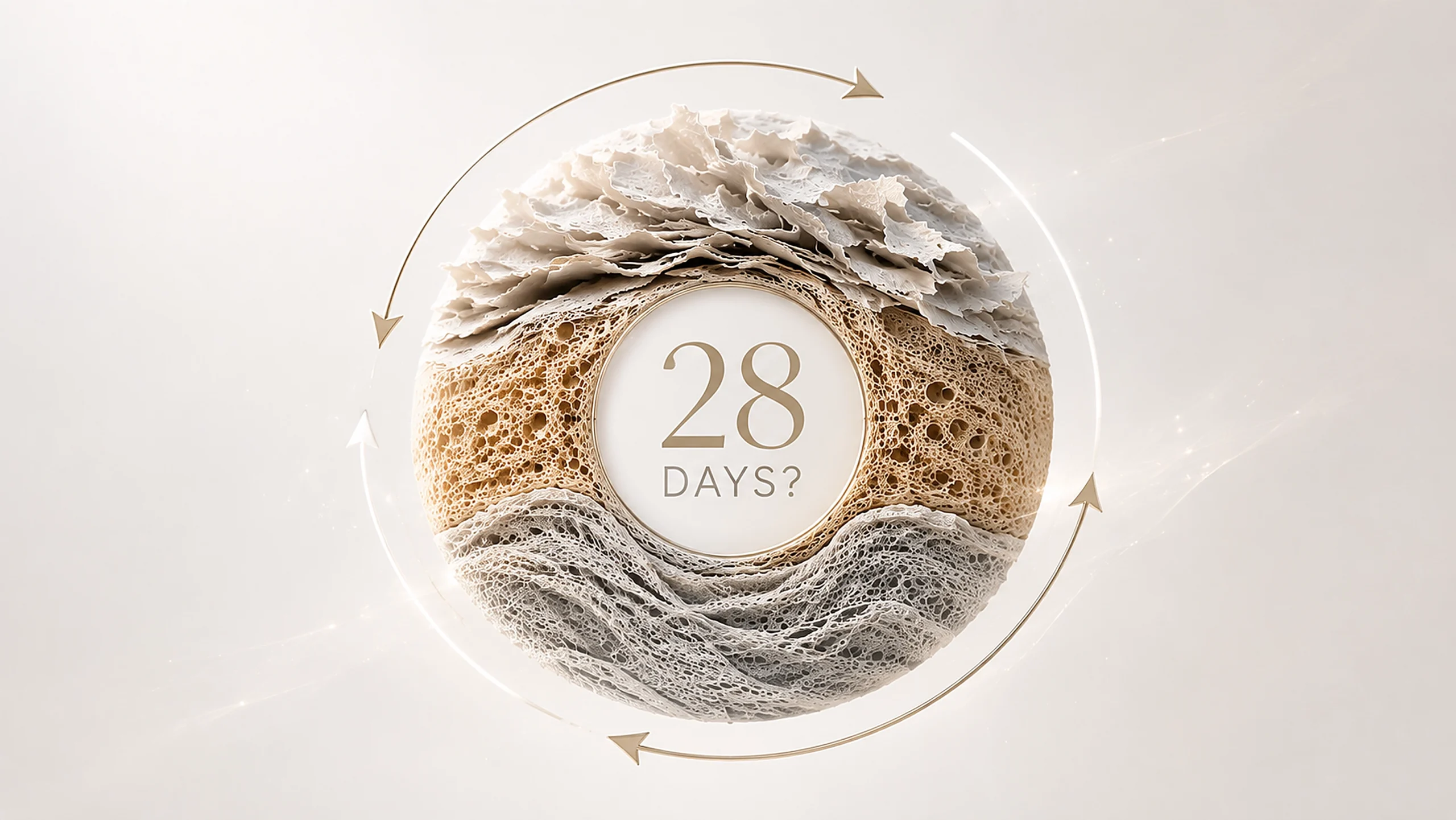
Twenty-eight days is skincare’s favourite biological deadline. Damage your barrier, strip the routine back, behave impeccably for a month and a fresh surface is expected to arrive with the problem solved.
Allegedly.
This is a satisfying story because the calendar is easy, but the biology runs on several clocks.
Barrier repair starts within hours of disruption. The living epidermis can release and make barrier lipids before an entirely new cohort of cells has migrated to the surface. Water loss may improve while surface chemistry and cell shape are still changing. Comfort can return before the skin has recovered enough resilience to meet the routine that upset it.
Twenty-eight days belongs to an old estimate of epidermal turnover. It was never a universal completion date for barrier repair.
The Famous Number Has a Family Tree
The familiar number begins with cell kinetics, not a damaging routine. In 1965, Gerald Weinstein and Eugene Van Scott used autoradiography to estimate that cells spent around 13 days moving through the viable epidermis. They added that to an earlier estimate of 13 to 14 days in the stratum corneum, produced by Simon Rothberg, Robert Crounse and John Lee, and arrived at 26 to 27 days for the entire epidermis.
The skincare figure of 28 days sits remarkably close to that total. It looks like the rounded descendant, although the exact route from 26 or 27 in a real scientific paper to 28 in skincare marketing is rarely documented. The family tree is certainly not supplied with the serum.
Neither group watched one cell leave the basal layer and keep walking until it fell from your face. They followed labelled biological material and inferred transit times. This is perfectly respectable science, especially for that time, but the answer depends on the marker, the skin site, the compartments included and the assumptions used to join them.
The timetable changed when the bookkeeping changed. In 1984, Gerald Weinstein, Jerry McCullough and Priscilla Ross used a more detailed kinetic analysis and estimated 39 days for total epidermal turnover. Ten years later, Hajime Iizuka revisited their data, separated the proliferative, differentiating and cornified compartments, and calculated 47 to 48 days. Same tissue, same published data, different accounting.
The lesson isn’t that 48 should replace 28 on an infographic. There is no magic number. Turnover time is an estimate built from a defined journey. Barrier recovery asks another question: how quickly does the epidermis regain control of permeability after disruption? Cell replacement contributes to that answer, but it doesn’t own the clock.
Repair Starts Before Replacement Finishes
The epidermis already contains the machinery it needs to respond. When water loss rises after a barrier challenge, cells can release lamellar-body contents, ramp up lipid synthesis and alter proliferation. The surface doesn’t have to wait for an entirely new workforce to arrive. This is part of how skin detects and answers barrier loss.
Erhard Proksch, Walter Holleran, Gopinathan Menon and colleagues demonstrated the timing in hairless mice in 1993. After they disrupted the permeability barrier with acetone, epidermal synthesis of cholesterol, free fatty acids and sphingolipids increased. Blocking cholesterol or sphingolipid synthesis slowed recovery. The extra lipid was reconstruction material, and the work began before anything resembling complete epidermal turnover could have occurred.
These were abrupt mouse experiments, so they cannot tell you how long a retinoid-irritated human cheek will take to settle. They can establish the sequence: repair begins through resident epidermal responses, while longer cellular renewal continues around it. The study was supported by the US National Institutes of Health, and no consumer product was under test.
Several Clocks, One Patch of Skin
Mihaela Gorcea, Jonathan Hadgraft, Majella Lane and David Moore made the competing schedules visible on living human skin. Their 2013 study repeatedly tape-stripped cheek sites in ten healthy adults aged 29 to 56, then followed the same sites for four weeks. Transepidermal water loss, or TEWL, tracked permeability; microscopy tracked corneocyte size; infrared spectroscopy tracked chemical signals at the surface.
The answers returned in stages. Signals assigned to surface lipid and sebum components were back within 24 hours. Protein and water signals recovered within a week. TEWL and corneocyte size did not settle back to baseline until four weeks. One piece of skin had given three defensible recovery dates.
This gives you a map rather than a deadline. On day two, a surface-composition measurement might say that one part of the response has returned while water movement and cell morphology have further to go. The instruments are not in disagreement. They are timing different jobs.
The study was exploratory and narrow: ten healthy adults, one facial site and a controlled tape-strip challenge. It cannot stand in for eczema, chronic irritant dermatitis or every kind of over-treated skin. The author affiliations also included Ashland Specialty Ingredients and TRI-Princeton alongside the University of London. The industry connection deserves to be registered because barrier measurement has commercial uses. It does not convert the result into an advert: no branded product or recovery treatment was compared. Here, the small sample and artificial challenge place the more immediate limits on the conclusion.
Baseline Can Hide Repair Reserve
Even when the endpoint stays the same, the person carrying the skin can change the schedule. Ruby Ghadially, Barbara Brown, Sandy Sequeira-Martin, Kenneth Feingold and Peter Elias compared adults aged 20 to 30 with adults over 80. Baseline TEWL was lower in the older group, so an undisturbed reading did not announce a weak barrier. The challenge did.
Older skin required fewer tape strips to reach a comparable level of disruption: 18 on average, against 31 in the younger group. After acetone treatment or tape stripping, the younger participants recovered about 50 per cent of permeability-barrier function within 24 hours and 80 per cent within 72 hours. The group over 80 had recovered about 15 per cent at 24 hours and remained delayed over the following days.
The researchers then found supporting structural and lipid abnormalities in aged mice, including less total stratum-corneum lipid and fewer extracellular lamellar bilayers. Human recovery and mouse mechanism are not interchangeable, but together they explain why a calm baseline can conceal less reserve. The skin may look as though it is keeping up until you ask it to recover from pressure.
This doesn’t make age a timer you can apply to an individual face. The study compared two distant age groups under deliberately controlled damage. It does show why a universal month ignores the biology of the person doing the repairing. The paper came from University of California, San Francisco, and US Veterans Affairs researchers and tested physiology, not a treatment.
When the Clock Keeps Restarting
A laboratory creates one defined disruption and then has the good manners to leave the site alone. Your bathroom is usually less disciplined. A harsh cleanse, another exfoliation, a retinoid increase, cold dry weather or the product you decided to retry can add pressure while the previous response is still under way.
I’ve done this myself: watched the stinging settle, decided that was close enough, brought an active back, and found myself at the same sink a week later wondering why the calendar had apparently lied. It hadn’t. I had changed the experiment halfway through.
This is why a countdown from the day you announced a barrier-repair routine can mislead you. The calendar starts with the decision. The tissue answers each fresh exposure. Early comfort is welcome, but it is not a completion certificate; the threshold for stinging can improve before the skin has regained enough resilience for its previous workload.
At home, you do not have an evaporimeter beside the toothbrush. You have patterns. Familiar products stop provoking heat or tightness. Flaking settles. Cleansing no longer leaves the face feeling one size too small. Most importantly, those changes remain stable through several ordinary days rather than disappearing as soon as the routine becomes ambitious again. These are not clinical barrier tests, but they are better evidence of tolerance than the date alone.
A mild, isolated disturbance may regain much of its water control within days. A stronger or repeated disruption can take weeks, and disease, age, medication and continuing exposure can extend the course. Persistent or worsening redness, cracking, swelling, pain or weeping deserves clinical assessment; a plausible skincare phrase should not be allowed to supervise everything indefinitely.
What Twenty-Eight Days Can Tell You
Does skin barrier repair take 28 days? It can take less than that for one endpoint and longer for another. Twenty-eight days can be a sensible review point if it helps you stop fiddling with the routine. It is a poor biological finish line.
Turnover describes a journey through the epidermis. Repair describes the return of permeability control, surface organisation and the ability to withstand ordinary pressure. The processes overlap, but they do not report for duty or sign off together.
Repair is the return of control, not the date a fresh set of skin arrives.
References
Weinstein, G.D. and Van Scott, E.J. (1965). Autoradiographic analysis of turnover times of normal and psoriatic epidermis. Journal of Investigative Dermatology, 45(4), pp. 257–262. https://doi.org/10.1038/jid.1965.126
Rothberg, S., Crounse, R.G. and Lee, J.L. (1961). Glycine-C14 incorporation into the proteins of normal stratum corneum and the abnormal stratum corneum of psoriasis. Journal of Investigative Dermatology, 37(6), pp. 497–505. https://doi.org/10.1038/jid.1961.150
Weinstein, G.D., McCullough, J.L. and Ross, P. (1984). Cell proliferation in normal epidermis. Journal of Investigative Dermatology, 82(6), pp. 623–628. https://doi.org/10.1111/1523-1747.ep12261462
Iizuka, H. (1994). Epidermal turnover time. Journal of Dermatological Science, 8(3), pp. 215–217. https://doi.org/10.1016/0923-1811(94)90057-4
Proksch, E., Holleran, W.M., Menon, G.K., et al. (1993). Barrier function regulates epidermal lipid and DNA synthesis. British Journal of Dermatology, 128(5), pp. 473–482. https://doi.org/10.1111/j.1365-2133.1993.tb00222.x
Gorcea, M., Hadgraft, J., Lane, M.E., et al. (2013). In vivo barrier challenge and long-term recovery in human facial skin. International Journal of Cosmetic Science, 35(3), pp. 250–256. https://doi.org/10.1111/ics.12034
Ghadially, R., Brown, B.E., Sequeira-Martin, S.M., et al. (1995). The aged epidermal permeability barrier: structural, functional, and lipid biochemical abnormalities in humans and a senescent murine model. Journal of Clinical Investigation, 95(5), pp. 2281–2290. https://doi.org/10.1172/JCI117919
This article contains no affiliate links, sponsored content or product recommendations. Scientific claims are grounded in the peer-reviewed literature cited above. The Gorcea study included author affiliations at Ashland Specialty Ingredients and TRI-Princeton alongside the University of London; it did not compare a commercial product or recovery treatment. Funding and affiliations are discussed in the text where they change how the evidence should be read.