For years, parts of the skincare industry have marketed the idea of ‘breathable’ skin. Petrolatum is usually cast as the villain: too heavy, too occlusive, liable to suffocate the tissue or trap unspecified toxins beneath the surface.
The word ‘breathable’ does a great deal of work here. Most of it doesn’t have much to do with breathing.
Does Skin Breathe?
The standard rebuttal is that skin does not breathe. Strictly, even that’s too simple.
In 2002, Markus Stücker and colleagues measured oxygen moving directly from the atmosphere into human skin. Their results and modelling indicated that, under the conditions tested, the upper 0.25 to 0.40 millimetres received most of their oxygen locally from the air rather than the bloodstream.
That finding is legitimate. Its contribution to whole-body respiration is negligible.
Human skin participates in limited local gas exchange, but it is not a meaningful respiratory route for the body. Nor does it depend on uncovered pores to clear toxins. Sweat contains dissolved metabolic compounds, but the skin is not a detoxification organ waiting for an occlusive moisturiser to block its exhaust.
More importantly, petrolatum does not behave like a sealed, impermeable membrane. The biological objection fails for a more interesting reason than the usual rebuttal allows.
‘Breathable’ is mostly a sensory description dressed as physiology.
The Problem Petrolatum Solves
The stratum corneum is designed to control movement across the skin’s surface. One of its central jobs is to slow water leaving the body while restricting the entry of external chemicals and irritants.
When its intercellular lipid architecture is disrupted, that control weakens. Water diffuses out more readily and transepidermal water loss, or TEWL, rises. The immediate result may be dryness or tightness, but the biological consequence reaches further. Corneocytes, the flattened, water-holding cells that make up the stratum corneum, lose flexibility. The surface becomes more vulnerable to mechanical strain, and the biochemical environment in which maintenance processes operate becomes less stable.
Water is not only responsible for making skin feel plump. It participates in the machinery.
In 2001, Allan Watkinson and colleagues varied humidity across an in-vitro stratum-corneum model. Corneocyte release declined as relative humidity fell, while the activity of the desquamatory enzyme now known as KLK7 was higher at 100 per cent relative humidity than at 44 per cent. Adding glycerol increased enzyme activity and desquamation further.
The experiment did not establish that every barrier enzyme responds identically. It demonstrated something more useful: water availability changes the conditions in which stratum-corneum processes operate.
Petrolatum addresses that environment by reducing outward water movement. Corneocytes retain more water and remain more flexible. The evaporative gradient falls. The damaged barrier is given a more stable surface in which recovery can proceed.
That’s the familiar explanation. It’s also incomplete.
Petrolatum Does More Than Sit on Top
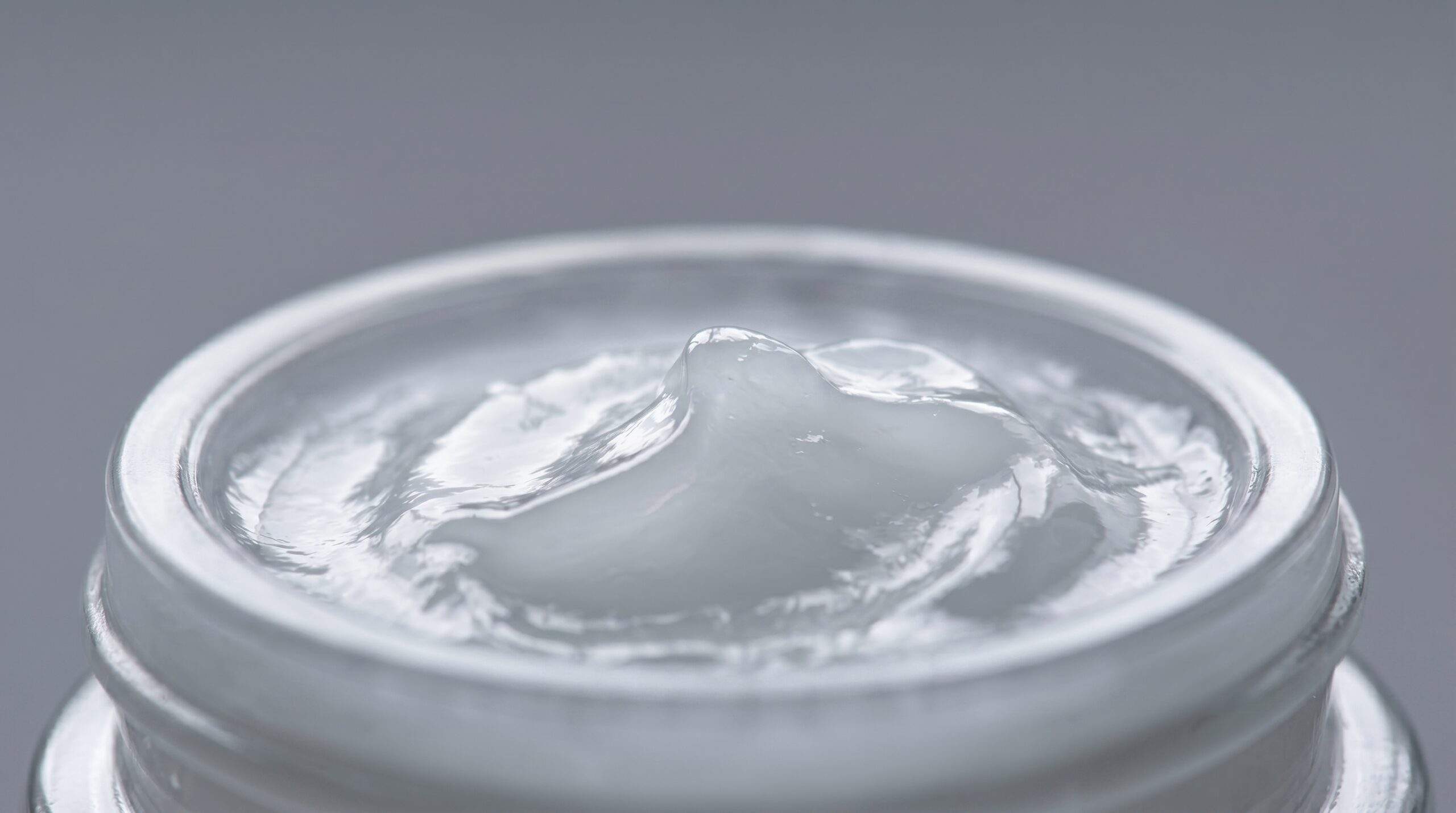
Highly refined petrolatum used in skincare is a semi-solid mixture of hydrocarbons. It does not supply ceramides, cholesterol, free fatty acids or Natural Moisturising Factor. It contains no peptide signal instructing keratinocytes to repair themselves. Its chemistry is almost boring.
For years, the assumption was that this material worked by forming an impermeable sheet across the surface. In 1992, Roshan Ghadially, Lars Halkier-Sørensen and Peter Elias tested that assumption directly.
They disrupted the barriers of human volunteers using acetone, then compared petrolatum-treated and untreated sites. If petrolatum only sealed water beneath an impermeable surface, previous animal work suggested that it might interfere with the signals coordinating barrier recovery.
It did the opposite.
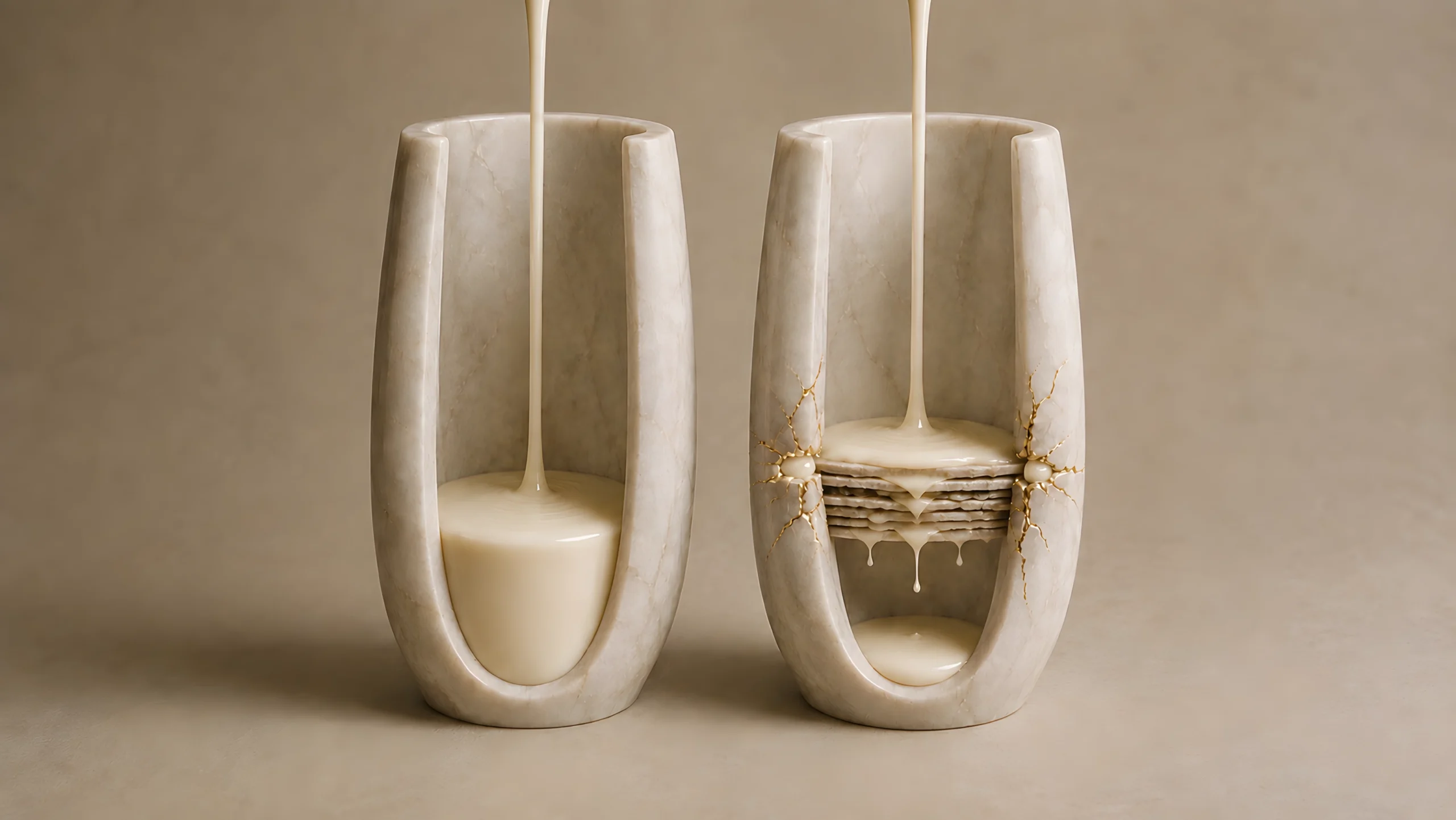
Petrolatum accelerated recovery in the human volunteers. In accompanying tracer studies in murine skin, it was located within intercellular spaces throughout the stratum corneum rather than solely as a film resting above it. It didn’t behave like plastic wrap placed over the tissue. It moved into the disrupted structure itself.
This should not be mistaken for physiological lipid replacement. Petrolatum does not become part of the endogenous ceramide lamellae or reconstruct their molecular organisation. The finding supports a more limited, but still important, role: petrolatum can occupy spaces within a disrupted stratum corneum while reducing water loss across it.
It doesn’t become the barrier. It provides temporary physical support while the barrier rebuilds itself.
The Case for Boring
The value of petrolatum lies in how little it requires from the skin.
It does not require receptor binding, enzymatic conversion or successful integration into a precisely organised lipid phase. It changes the physical conditions at the boundary between the stratum corneum and the environment. That makes it a low-demand intervention, particularly when the barrier has little regulatory margin available for anything more complicated.
Not all occlusion behaves the same way, though. Intermittent use, the way most people apply it in an evening routine, lowers evaporative stress without keeping the surface continuously overhydrated. Continuous or prolonged occlusion is a different exposure. It can overhydrate and macerate the stratum corneum, and it increases the penetration of anything trapped underneath, which is part of why clinical wet wrapping is done in controlled windows rather than left on indefinitely. More occlusion isn’t automatically better. The goal is reducing evaporative stress, not sealing the surface shut.
If you’ve ever had a stretch of skin recovery where the single most helpful thing turned out to be a plain, unfragranced jelly at night, and felt a bit baffled that something so boring was doing the work, that’s why.
This doesn’t make petrolatum a complete treatment. It cannot remove the chemical exposure, inflammation, environmental pressure or underlying disease that damaged the barrier. What it can do is reduce one immediate consequence of that damage while shielding the surface from further pressure.
Support is not the same as reconstruction. It is still biologically consequential.
Skincare tends to favour ingredients with elaborate stories because elaborate stories are easier to position as innovation. Petrolatum has almost no story at the ingredient level. Its story begins at the tissue level.
Damaged skin doesn’t need the marketing version of ‘breathability.’ It needs control over what leaves and what enters. Petrolatum reduces evaporative loss, occupies disrupted interstices and creates more stable conditions for endogenous recovery.
Sometimes the most biologically intelligent thing a product can do is stop asking the biology to do more.
References
Ghadially, R., Halkier-Sørensen, L. and Elias, P.M. (1992). Effects of petrolatum on stratum corneum structure and function. Journal of the American Academy of Dermatology, 26(3 Pt 2), pp. 387–396. https://doi.org/10.1016/0190-9622(92)70060-S
Stücker, M., Struk, A., Altmeyer, P., et al. (2002). The cutaneous uptake of atmospheric oxygen contributes significantly to the oxygen supply of human dermis and epidermis. The Journal of Physiology, 538(Pt 3), pp. 985–994. https://doi.org/10.1113/jphysiol.2001.013067
Watkinson, A., Harding, C., Moore, A., et al. (2001). Water modulation of stratum corneum chymotryptic enzyme activity and desquamation. Archives of Dermatological Research, 293(9), pp. 470–476. https://doi.org/10.1007/s004030100257
Elias, P.M. (2005). Stratum corneum defensive functions: an integrated view. Journal of Investigative Dermatology, 125(2), pp. 183–200. https://doi.org/10.1111/j.0022-202X.2005.23668.x
Rawlings, A.V. and Harding, C.R. (2004). Moisturization and skin barrier function. Dermatologic Therapy, 17(Suppl 1), pp. 43–48. https://doi.org/10.1111/j.1396-0296.2004.04s1005.x
A short note: This article contains no affiliate links, sponsored content or product recommendations. Scientific claims are grounded in the peer-reviewed literature cited above.